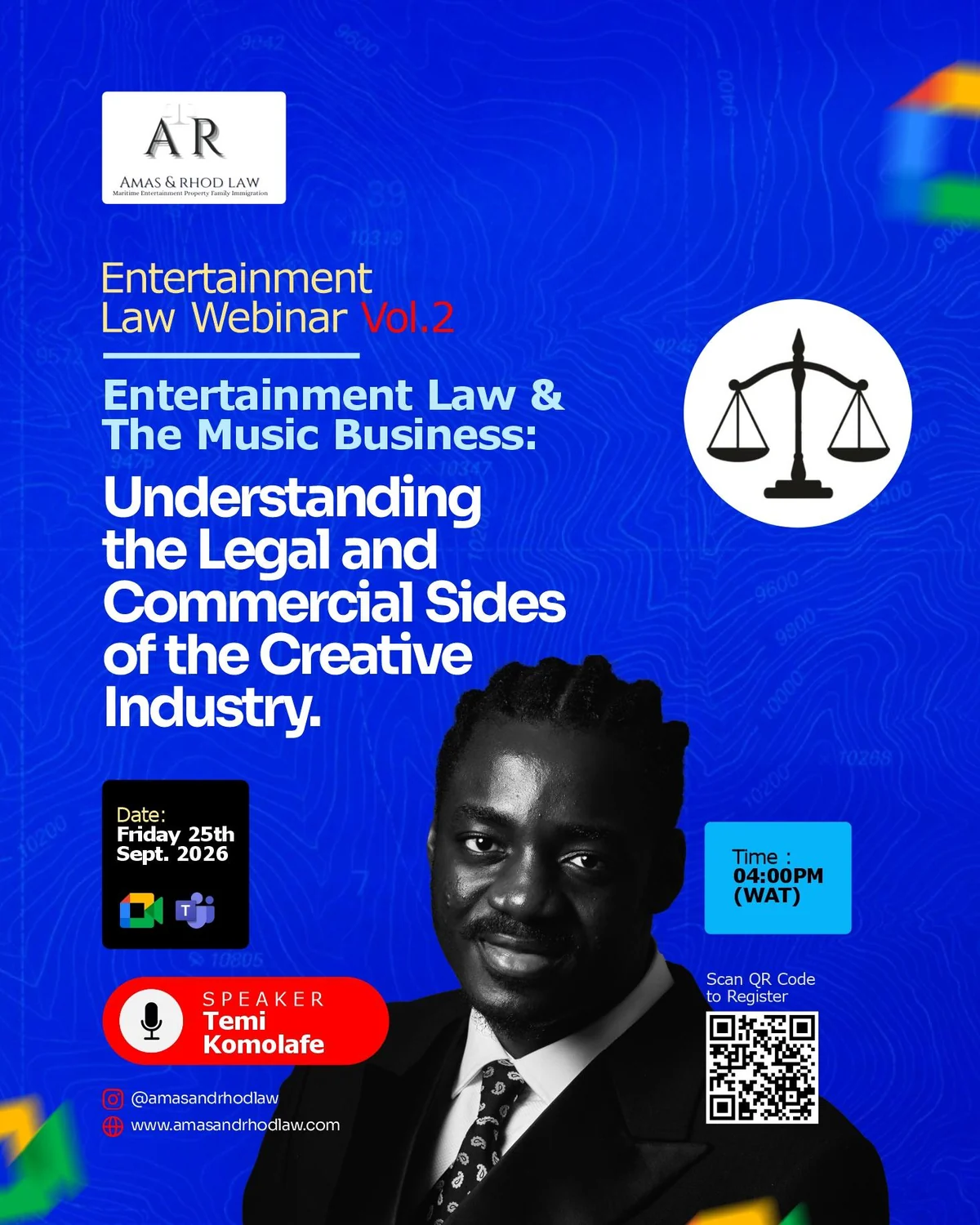
Royalties in Nigerian Entertainment Law: Protecting the Value Behind Every Song
Every stream, every performance, and every download tells a legal story. Behind the melody and rhythm of music lies a complex framework of rights, ownership, and value. In entertainment law, royalties are the lifeblood of creators, ensuring that their intellectual property is not only appreciated but also rewarded. Two of the most important types are mechanical royalties and publishing royalties.
Mechanical royalties arise whenever a song is reproduced or distributed. This includes streaming on platforms like Spotify, Boomplay, or Apple Music, digital downloads from iTunes or Amazon, and even physical sales of CDs or vinyl records. In simple terms, if your song is copied in any format for listeners to enjoy, you are entitled to mechanical royalties. These royalties recognize that reproduction is not free, it is a commercial use of your creative work.
Publishing royalties, on the other hand, are earned when a song is performed or communicated to the public. This covers radio and television broadcasts, live performances in clubs or concerts, and synchronization rights when music is used in films, advertisements, or video games. For example, if your song is played during a Nollywood movie or used in a Coca-Cola advert, you earn publishing royalties. These royalties ensure that whenever your music is shared with the pu blic, you are compensated for its use.
The Nigerian legal framework is anchored in the Copyright Act, Cap C8, Laws of the Federation of Nigeria 2004, which grants authors and composers exclusive rights to control reproduction, distribution, performance, and communication of their works. Section 6 of the Act specifically provides that copyright owners have the right to authorize or prohibit reproduction and public performance of their works. This statutory protection ensures that creativity is not only appreciated but also rewarded.
Judicial interpretation has reinforced these principles. In Musical Copyright Society of Nigeria Ltd/Gte v. Compact Disc Technologies Ltd (2008) 10 NWLR (Pt. 1096) 349, the Court of Appeal affirmed the right of copyright collecting societies to enforce royalties on behalf of artists. Similarly, in Performing Musicians Employers Association of Nigeria v. Nigerian Copyright Commission (2010) 11 NWLR (Pt. 1205) 495, the courts recognized the importance of collective management organizations in safeguarding the interests of musicians and ensuring that royalties are properly collected and distributed.
For creators, the practical implications are clear. Every contract, license, or distribution agreement must be carefully reviewed to ensure that royalty entitlements are preserved. Too often, artists sign away their rights without fully understanding the long-term consequences. Seeking legal guidance before entering into agreements is therefore essential.
Ultimately, royalties embody the principle that creativity has economic value. Mechanical royalties protect your right to earn when your music is reproduced, while publishing royalties protect your right to earn when your music is performed or broadcast. Together, they ensure that behind every song lies not just melody and rhythm, but also legal recognition and financial reward. For Nigeria’s growing entertainment industry, strengthening royalty enforcement is key to sustaining the livelihoods of creators and protecting the integrity of intellectual property law.
Written by ,
N.C MUOJEKWU Esq
Legal counsel at Amas and Rhod law

Barrister Muojekwu
Barrister Muojekwu, Associate at Amas & Rhod Law